


RESEARCH DIALOGUE
What Do Leaders Need to Develop in an Age of Complexity?
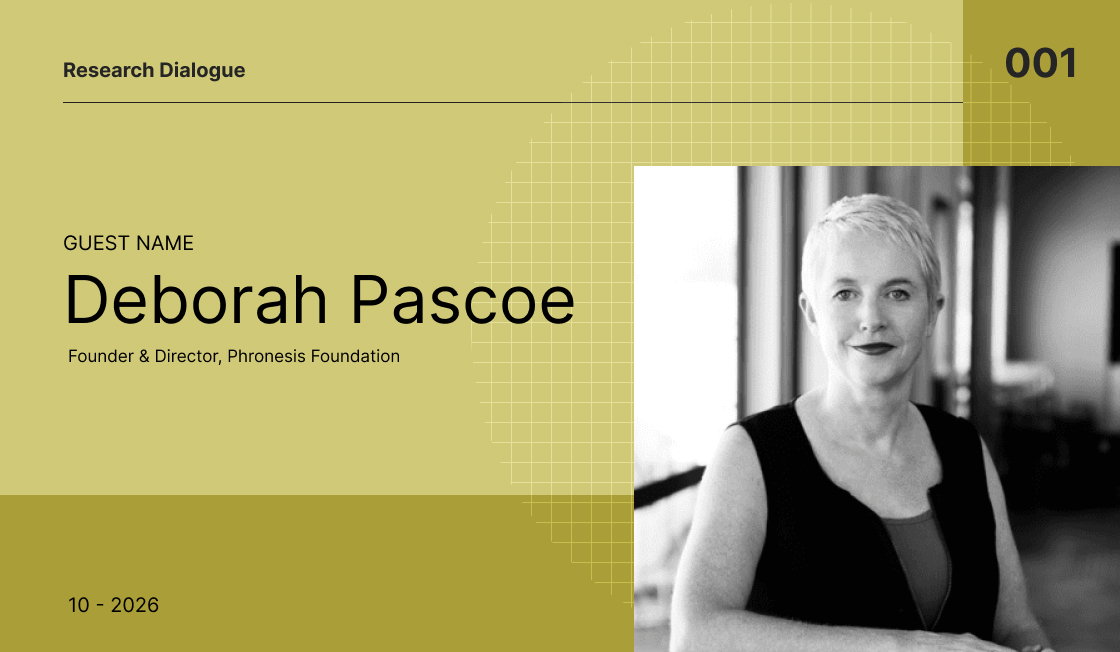
Reflections from my dialogue with Deborah Pascoe
01What exactly are we developing in leaders?
After working in leadership development for many years, I often return to a fundamental question: what exactly are we trying to develop in leaders? Knowledge? Skills? Behaviour? Or the very capacity through which people perceive, interpret and make meaning of the world?
My ongoing dialogue with Australian leadership development practitioner and researcher Deborah Pascoe has brought this question into sharper focus. Deborah’s doctoral research, “Developing Dynamic Leadership Skills for Navigating Complexity,” explores what dynamic leadership skills leaders need to navigate complex and uncertain organisational life, and how those skills can be developed.
Her work seeks to bridge leadership theory and practice by connecting leadership and adult development, drawing on Integrative Developmental Science and Dynamic Skill Theory.
02What is different about leaders who can navigate complexity?
Deborah’s research uses in-depth interviews with C-suite leaders in Victorian public hospitals to explore how senior executives navigate complexity. A particularly compelling aspect is its attention to micro-level skills that may be implicit even to the leaders using them. It also asks what skills may be underdeveloped when leaders describe situations in which they felt overwhelmed by complexity.
This connects strongly with what I observe in practice. Successful leaders often have deep experience, expertise and judgement. Yet as complexity increases, the very certainty that once enabled success can make it harder to see a changing reality.
Leadership development is not only about knowing more. It is also about becoming more capable of questioning what we already know.
03Turning Intellectual Humility into practice
One concept I am increasingly exploring is Intellectual Humility. I do not mean simply being modest. I mean recognising the limits and fallibility of one’s own knowledge and beliefs, and responding appropriately to that recognition.
One of the most useful ideas in my dialogue with Deborah has been to move from treating Intellectual Humility as an abstract quality to breaking it down into trainable mini- and micro-skills: noticing what is missing from my understanding, resisting premature closure, holding more than one plausible account at the same time, staying with uncertainty, seeking different perspectives, and updating my thinking when new evidence appears.
Telling a leader to “be more intellectually humble” rarely changes behaviour. Asking a leader to pause and ask, “What else might be true?” is something that can be practised tomorrow. As a practitioner, I am deeply interested in this translation from developmental construct to repeatable practice.
04Can deep expertise cultivate humility? A reflection from Northern Farm
Our conversation unexpectedly moved to one of Teambox’s clients, Northern Farm. Its managers include highly specialised professionals in horse training, breeding and farriery. In terms of horizontal development, many possess exceptional depth of knowledge and skill.
Yet their everyday work repeatedly reminds them that expertise has limits. A horse is a living being that can never be fully controlled. What worked yesterday may not work today. They must observe, wait, question their judgement, learn from the horse, and change their approach.
This has led me to wonder whether Intellectual Humility is not only something we teach in a leadership classroom. Perhaps it can emerge through repeated experience with uncertainty. The question then changes from “How do we teach Intellectual Humility?” to “What experiences, practices and contexts make Intellectual Humility more likely to emerge?”
05Unlearning and Dialectical Thinking
In my own work, I have been developing a five-step Unlearning Leadership Model: Recognize → Question → Unlearn → Reconstruct → Lead Forward. Increasingly, however, I think it is insufficient to understand unlearning simply as discarding an old idea and replacing it with a new one.
Expertise or humility. Direction or empowerment. Confidence or doubt. In real leadership, the task is rarely to choose only one side. A leader may need deep expertise while remaining aware of its limits; to provide direction while creating space for others; to act with confidence while retaining the possibility that they may be wrong.
This is where Dialectical Thinking has begun to enter my own thinking. It is the capacity to hold apparently contradictory truths without closing too quickly on one side, and to stay with the tension long enough for a more complex understanding to emerge. I am beginning to wonder whether Dialectical Thinking is not a sixth step in my model, but a developmental capacity that enables the entire unlearning process.
This also connects with Negative Capability: consciously remaining with uncertainty, ambiguity and not-knowing rather than rushing toward closure. It does not mean avoiding decisions indefinitely. It means staying with discomfort long enough to create space for something unexpected to emerge.
06The question I now want to pursue
As I prepare for doctoral study in Human Development, I am working with a larger question:
What kind of human development enables leadership in an increasingly complex world?
Through my dialogue with Deborah, I am beginning to see Intellectual Humility, Negative Capability, Dialectical Thinking, Unlearning, and the reconstruction of meaning-making as potentially important parts of this larger question. I have not yet fully conceptualised how they relate. That is precisely why I want to study them.
A further question is emerging:
What experiences, practices, and contexts enable leaders to transform how they make meaning in complexity?
Perhaps the future of leadership development is not about giving leaders more correct answers. It may be about creating developmental experiences in which they question their own certainty, seek different perspectives, resist premature closure, stay with not-knowing, loosen their attachment to assumptions that once made them successful, and construct new meaning. This is the territory I want to continue exploring through both research and practice.
About Deborah Pascoe
Deborah Pascoe is a leadership development practitioner and researcher and Director of the Phronesis Foundation. Her doctoral research explores Dynamic Leadership Skills required to navigate complexity and how those skills develop. Her work connects leadership and adult development and draws on Dynamic Skill Theory to investigate how leaders identify, practise, cultivate and enact the skills required in contemporary organisational life.
This article is based on the doctoral research abstract shared by Deborah Pascoe and on her ongoing dialogue with Chieko Seta. Interpretations and emerging hypotheses attributed to Chieko are presented as Chieko’s reflections rather than as claims of Deborah’s research.
 Back to Research Dialogue